$ open posts/ai-gains-a-body-humanoid-robots-physical-ai-manufacturing
AI Gains a Body: Humanoid Robots and Physical AI Transform Manufacturing
The vision of intelligent machines working alongside humans is rapidly becoming a reality. As artificial intelligence continues its exponential growth, it is increasingly gaining a physical presence, with humanoid robots and advanced 'physical AI' systems stepping into critical roles within manufacturing and logistics. This shift marks a profound evolution, transforming how industries operate, enhance productivity, and tackle persistent labor shortages.
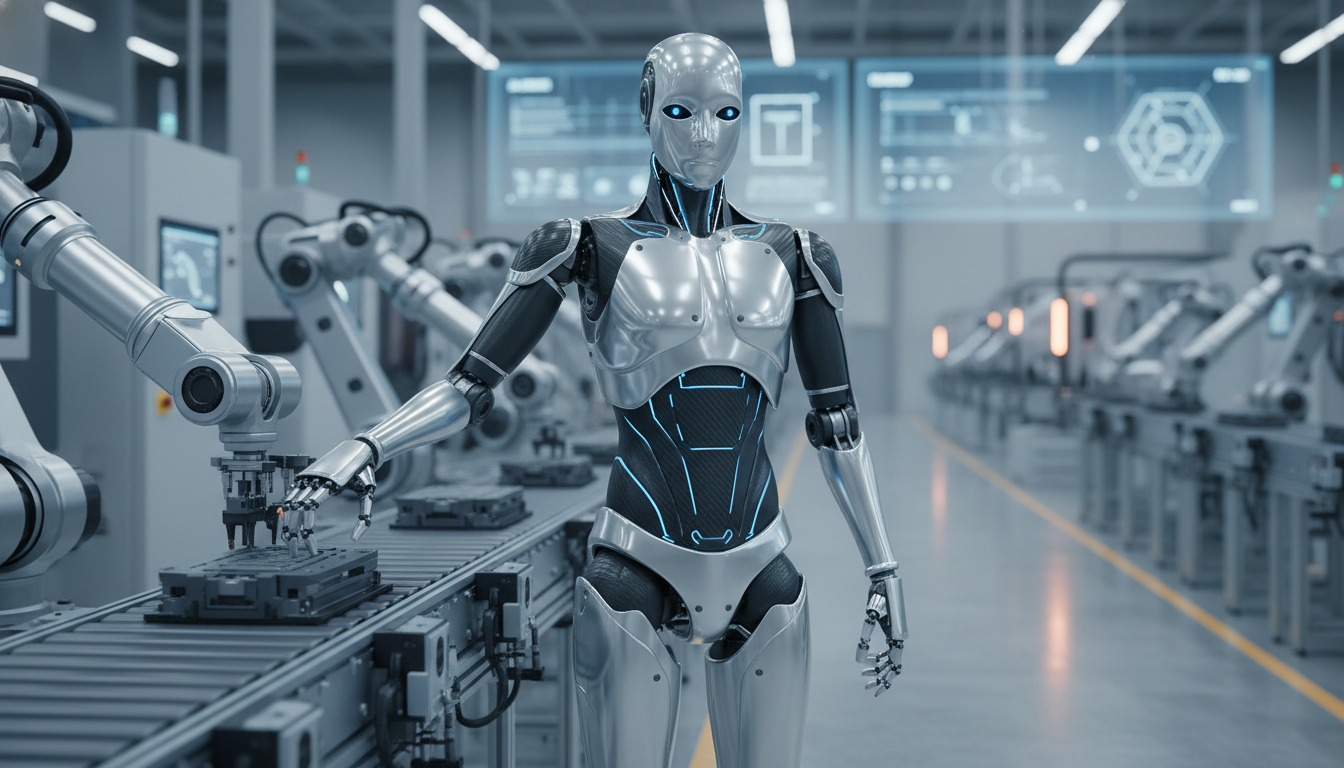
This is not merely about automation; it's about embodied intelligence. Physical AI refers to intelligent systems that interact with the real world through physical actions, learning and adapting in complex environments. Humanoid robots, with their human-like form factors, are at the forefront of this revolution, designed to navigate and perform tasks in spaces traditionally built for people.
The Emergence of Embodied AI in Industry
The robotics landscape is experiencing a dramatic transformation, moving beyond specialized industrial arms to general-purpose humanoid systems. This new wave of physical AI is not just a technological marvel but a strategic imperative for industries facing labor constraints and the demand for greater efficiency. The past year has seen significant milestones, indicating a clear trajectory towards widespread adoption.
Rapid Investment Fuels a New Robotics Era
Investor confidence in humanoid robotics and physical AI is soaring. Robotics startups globally raised an impressive $13.8 billion in 2025, a substantial increase from $7.8 billion in 2024, with 2026 on track to exceed these figures. The humanoid robotics sector alone crossed $500 million in global sales revenue for the first time in 2025. By April 2026, humanoid robot companies had secured $1.61 billion in equity funding, marking a 224.88% rise year-over-year. Projections from leading financial institutions underscore this potential: Goldman Sachs anticipates the humanoid robotics market will reach $38 billion by 2035, while Barclays Research estimates it could hit $200 billion by the same year. IDTechEx forecasts annual shipments nearing 1.8 million units by 2036, with the market reaching approximately $25 billion by the early 2030s.
This growth is further fueled by decreasing costs and faster payback periods. Average selling prices for humanoid robots are projected to drop from around $114,700 in 2024 to about $37,000 by 2030. Favorable industrial deployments could reduce payback periods to roughly six months by 2026, making these investments increasingly attractive for manufacturers. General Purpose Humanoids, designed for a variety of tasks, have attracted the most investor attention, securing $2.33 billion in funding in the past 12 months as of May 2026.
Humanoid Robots Step Onto the Factory Floor
Several companies are leading the charge, developing and deploying humanoid robots that are already proving their worth in real-world manufacturing and logistics environments. These innovators are not just building robots; they are building ecosystems for physical AI to thrive.
| Company | Flagship Robot | Key Deployment/Focus | Production/Funding Highlight |
|---|---|---|---|
| Figure AI | Figure 02, Figure 03 | BMW Group Plant Spartanburg (parts loading) | $1.9B funding, $39B valuation; BotQ facility (12,000 units/year) |
| Tesla | Optimus (Gen 3) | Tesla Fremont factory (internal production) | Fremont aims for 1M units/year by late 2026; target cost $20,000 |
| Agility Robotics | Digit | GXO Logistics, Schaeffler Group (100 plants by 2030) | RoboFab (10,000+ units/year); Agility Arc cloud platform |
| Sanctuary AI | Phoenix (Gen 7) | Magna International Inc. (manufacturing facilities) | Partnership with Microsoft; Accenture strategic investment |
| Boston Dynamics | Atlas | Hyundai's Georgia plant (factory work) | New fully electric Atlas; 30,000 units/year by 2028 for Hyundai |
| Apptronik | Apollo | Mercedes-Benz, GXO Logistics, Jabil (factories, warehouses) | $935M Series A funding; $5.5B valuation |
Leading Innovators and Their Industrial Footprint
Figure AI has made significant strides, deploying its Figure 02 robots at BMW Group Plant Spartanburg, where they logged over 1,250 hours and handled more than 90,000 parts, contributing to the production of over 30,000 BMW X3 vehicles. The company also announced BotQ, a manufacturing facility designed to produce 12,000 humanoids annually, and introduced Figure 03 with enhanced hardware and software for general-purpose learning.
Tesla's Optimus is set to revolutionize its own production lines. In Q1 2026, Tesla confirmed the conversion of its Fremont factory into a large-scale Optimus production line, with manufacturing slated to begin in late July or August 2026, targeting an annual capacity of 1 million units by year-end. A second factory at Gigafactory Texas aims for an astounding 10 million robots per year by summer 2027, with Elon Musk targeting a manufacturing cost of $20,000 per unit at scale.
Agility Robotics' Digit has already begun commercial logistics operations at a GXO facility. A strategic partnership with Schaeffler Group in November 2024 plans for Digit deployments across 100 plants worldwide by 2030. Agility's RoboFab facility in Oregon can produce over 10,000 robots annually, supported by its cloud platform, Agility Arc, for fleet management.
Sanctuary AI's Phoenix, now in its seventh generation, is being developed for general-purpose AI tasks. The company formed a strategic partnership with Magna International Inc. to deploy its robots in Magna's manufacturing facilities and is collaborating with Microsoft to accelerate AI development. Accenture also made a strategic investment in Sanctuary AI in March 2026, signaling confidence in its approach.
Boston Dynamics' Atlas, known for its dynamic movement, is being trained for factory work at Hyundai's Georgia plant, with deployments scheduled for 2026. A new, fully electric Atlas robot, unveiled in January 2026, is specifically designed for manufacturing and large-scale deployment. Hyundai plans to internally manufacture up to 30,000 Atlas robots per year by 2028.
Transforming Production with Physical AI
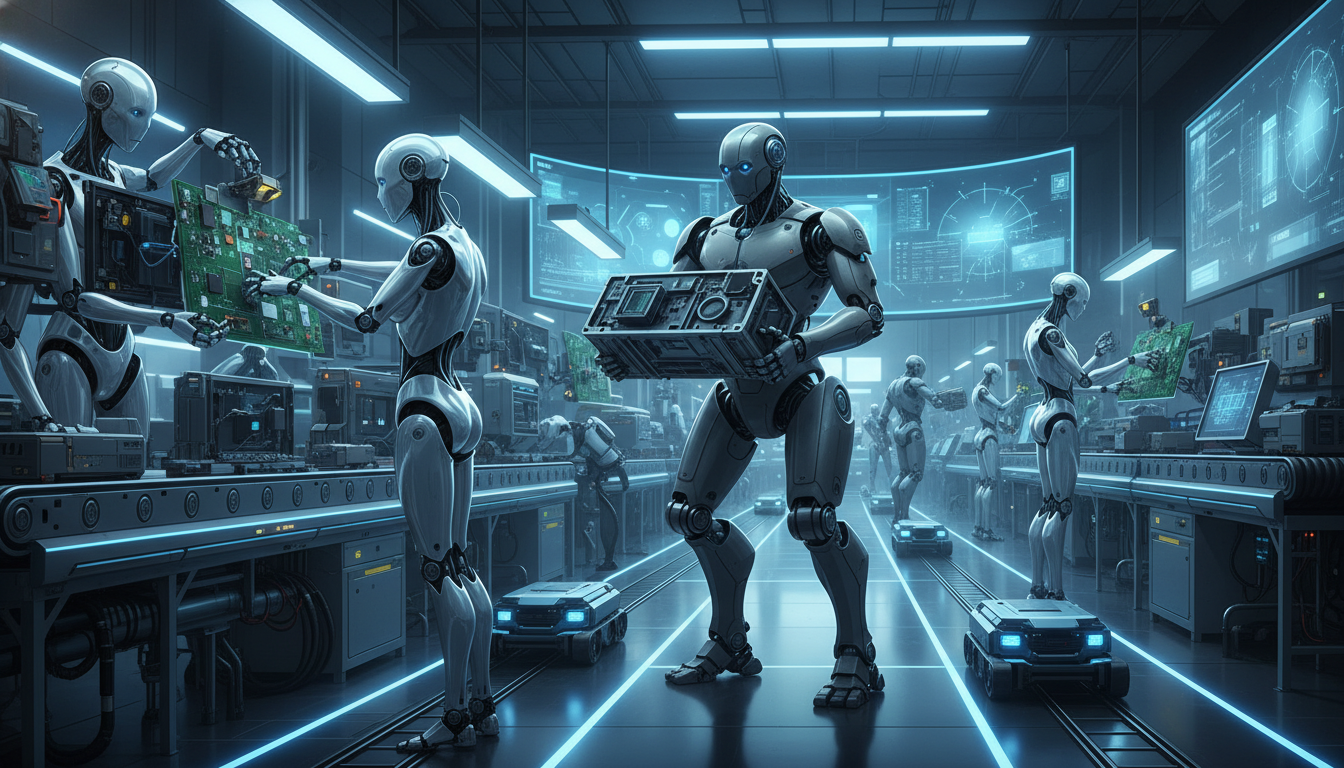
The impact of physical AI extends beyond individual humanoid deployments to a broader transformation of manufacturing processes. Manufacturers are increasingly integrating task-specific AI applications for everything from welding and sanding to inspection and complex assembly. This allows robots to manage variability in parts and processes, performing operations with a level of adaptability previously impossible.
The statistics paint a clear picture of this accelerating trend: 96% of machine builders are already leveraging AI in their internal operations, with 55% having scaled specific AI use cases. The robotics and semiconductor equipment industries are at the forefront of AI adoption among machinery sub-industries. Looking ahead, 22% of manufacturers plan to use physical AI by 2027, more than double the 9% currently using it. By 2028, a significant 74% of manufacturers expect AI agents to manage 11-50% of routine production decisions.
Collaborations like Siemens and NVIDIA's initiative to develop the world's first fully AI-driven, adaptive manufacturing sites, starting in 2026 with the Siemens Electronics Factory in Erlangen, Germany, highlight the strategic importance of this integration. Humanoid robots, driven by sophisticated AI, are poised to fill critical labor gaps, particularly in repetitive, dangerous, or physically demanding tasks, allowing human workers to focus on higher-value activities.
The journey of AI gaining a physical body is well underway, promising a future where intelligent machines are an integral part of the manufacturing ecosystem, driving efficiency, innovation, and resilience across industries. The rapid advancements and substantial investments indicate that this transformation is not a distant dream, but an unfolding reality.