$ open posts/big-tech-ai-assistant-lineup-siri-gemini-copilot-alexa
Big Tech's AI Assistant Lineup: Siri, Gemini, Copilot, and Alexa Catalogs Evolve
The realm of artificial intelligence assistants is undergoing a profound transformation. What began as simple voice commands and reactive tools has rapidly matured into a sophisticated ecosystem of proactive, context-aware, and deeply integrated AI agents. From Apple's Siri to Google's Gemini, Microsoft's Copilot, and Amazon's Alexa, each tech giant is vying for supremacy in a market projected to reach $73.8 billion by 2033, driven by a global shift where 70% of employees now engage with AI tools daily.
This evolution isn't merely about incremental updates; it's a fundamental reimagining of how we interact with technology. AI assistants are no longer confined to answering basic queries; they are becoming autonomous systems capable of executing complex tasks, managing workflows, and offering multimodal interactions that blend voice, vision, and text seamlessly. The race is on to embed AI as a foundational layer, making these assistants vital components of our personal and professional digital lives.
The Evolving Landscape of Big Tech AI Assistants
The strategic plays by Apple, Google, Microsoft, and Amazon highlight a common trajectory: moving beyond simple conversational interfaces to fully agentic AI. This means assistants that can understand intent, maintain context across multiple interactions, and proactively complete tasks across various applications and services. The emphasis is on personalization, efficiency, and a more natural human-computer interface.
By 2026, generative AI has transitioned from experimental curiosity to full structural integration, making these advanced assistants indispensable. Executives report significantly higher confidence in AI outputs compared to just two years prior, a testament to improved grounding in private data and more robust governance frameworks.
Apple's Siri AI: Privacy Meets Power
At WWDC 2026, Apple unveiled "Siri AI," a significant overhaul powered by Apple Intelligence. This new iteration is deeply woven into the fabric of iPhone, iPad, Mac, Apple Watch, and Apple Vision Pro. Siri AI can now leverage personal context from apps like Mail, Messages, and Calendar to tackle complex, multi-step questions and execute actions directly within applications.
A notable strategic shift is Apple's partnership with Google, confirming that some Siri workloads are now powered by Google's Gemini. While Apple continues to prioritize on-device AI for privacy, this collaboration underscores the necessity of cloud resources for complex reasoning and large-scale computation. Apple's Private Cloud Compute (PCC) infrastructure, designed with stringent privacy protocols, will expand to process certain Apple Intelligence workloads on Google Cloud.
New features in iOS 27 include on-screen awareness, allowing Siri to "see" and act upon content displayed on the iPhone screen, and visual intelligence integrated into the Camera app. Siri AI will also feature a dedicated app for conversation history and improved natural, expressive voices with customization options. The "Write with Siri" function empowers users to generate and edit text through natural language descriptions. Siri AI is currently in developer testing, with a beta for users later this year, though it will not be available in the EU or China initially.
Google's Gemini: Ecosystem-Wide Intelligence
Google's strategy is to embed Gemini deeply across its entire ecosystem, transforming AI into a runtime layer rather than merely an application. Gemini 3.5 is engineered for complex, multi-step agentic workflows, while Gemini Omni utilizes a multimodal reasoning pipeline to process images, audio, and text into high-quality video outputs.
The Gemini app is evolving into a proactive personal assistant, offering intuitive UIs, personalized daily briefs, and the ability to manage inboxes and schedule appointments. Its "Personal Intelligence" connects to user data across Gmail, Photos, Drive, and Search to deliver highly personalized answers. Gemini's integration into Google Workspace (Gmail, Docs, Sheets, Slides, Meet, Chat) streamlines tasks like writing, summarizing, and data analysis.
New features for small businesses, rolling out globally this month, allow Gemini to connect with Google Business Profiles, accessing customer reviews and performance data for tailored recommendations. Gemini in Chrome, expanding to desktop and iOS users in various regions, offers content summarization, cross-tab information comparison, and integration with Google apps like Calendar and Maps. Google continues to invest heavily in custom Tensor Processing Units (TPUs), including the TPU 8t and TPU 8i, for AI training and inference, with plans to offer these to select customers.
Microsoft Copilot: Agentic Workflows and Customization
Microsoft Copilot is rapidly transitioning from a chat assistant to a robust autonomous agent platform, deeply integrated with Microsoft 365 apps like Word, Excel, PowerPoint, Outlook, and Teams. Its purpose is to automate tasks, analyze data, and generate content seamlessly within the workplace.
In March 2026, Microsoft unified its consumer and commercial Copilot efforts, aiming for a consistent experience. Copilot Studio empowers businesses to build custom AI agents that automate complex workflows, with new 2026 features including computer use capabilities for automating web and desktop apps (GA May 2026) and agents optimized for Microsoft 365 users (Preview June 2026). Microsoft 365 Premium (formerly Copilot Pro) offers individual users custom AI agents, including the ability to create source-cited research reports and gain preferred access to AI models.
Key features for 2026 include enhanced Excel data analysis, Teams meeting summaries, intelligent document summarization, and custom AI agents. Copilot Notebooks can reference individual Teams meetings as knowledge sources and generate Excel spreadsheets. Microsoft Build 2026 underscored agentic AI as the next computing platform, with Windows evolving into an AI-native operating system. Microsoft also introduced seven in-house MAI models, new Cobalt 200 silicon, and the Majorana 2 quantum chip, signaling a strategic move to reduce reliance on external AI infrastructure.
Amazon's Alexa+: Conversational Powerhouse
At CES 2026, Amazon unveiled "Alexa+," a next-generation AI assistant designed to be a sophisticated conversational partner capable of complex tasks and multi-turn dialogues. Alexa+ is powered by Amazon's Nova large language models, augmented by Anthropic's Claude technology, positioning it as a formidable competitor in the AI assistant space.
Significantly, Alexa+ is free for all 180 million US Prime members and is compatible with 97% of existing Amazon devices, including Echo smart speakers, Echo Show displays, Fire TV, and Fire Tablets. This broad accessibility ensures a massive user base can immediately benefit from its enhanced capabilities.
Key features include a conversational chat interface on Echo devices with screens, natural multi-turn dialogue, agentic capabilities for task completion, deep personalization, memory retention, and proactive assistance. Alexa+ can understand casual, fragmented language and interruptions, answer richer questions, generate creative content, and reason through complex tasks. It integrates with thousands of services for tasks ranging from managing to-do lists to booking services. Alexa+ is also expanding internationally, with its arrival in France noted in June 2026. Amazon plans to invest $200 billion in AI capital expenditures in 2026, primarily for AWS data centers, servers, and custom-chip development, including its own Trainium 2 chips to reduce reliance on Nvidia.
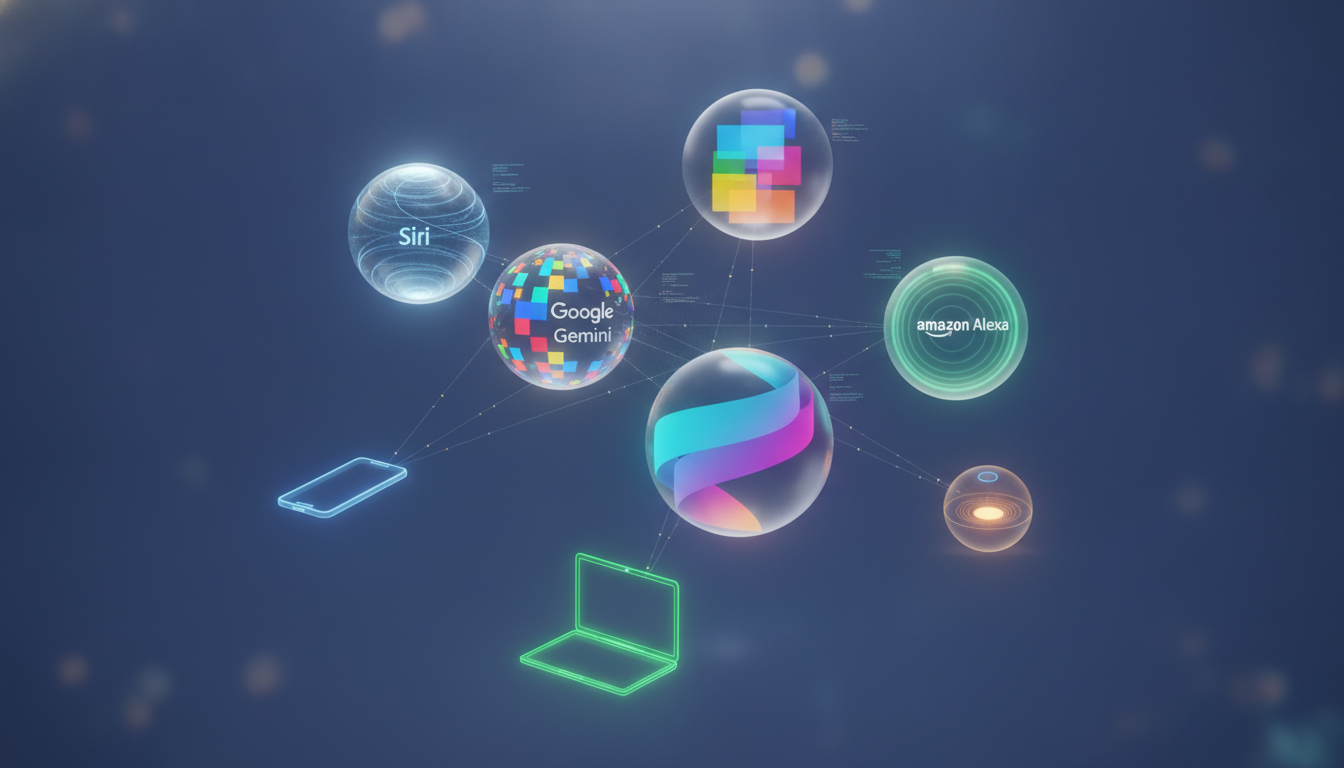
Comparative Overview: Key Differentiators
While all four tech giants are pushing the boundaries of AI assistants, their approaches and strengths exhibit distinct characteristics:
| Feature / Assistant | Apple Siri AI | Google Gemini | Microsoft Copilot | Amazon Alexa+ |
|---|---|---|---|---|
| Core AI Models | Apple Intelligence, Google Gemini (for some workloads) | Gemini 3.5, Gemini Omni | Microsoft MAI models, OpenAI models | Amazon Nova LLMs, Anthropic's Claude |
| Key Integrations | iOS, iPadOS, macOS, visionOS, Mail, Messages, Calendar | Android, Search, ChromeOS, Workspace (Gmail, Docs), Chrome | Microsoft 365 (Word, Excel, Teams, Outlook), Windows | Echo devices, Fire TV, Fire Tablets, Alexa for Shopping, thousands of services |
| Strategic Focus | Privacy-centric on-device AI, seamless ecosystem integration, personal context awareness | Ecosystem-wide AI runtime, agentic workflows, multimodal reasoning, personalized intelligence | Autonomous agent platform, enterprise productivity, custom agent creation via Copilot Studio | Conversational prowess, broad device compatibility, proactive assistance, Prime member value |
| Unique Selling Points | Private Cloud Compute, on-screen awareness, "Write with Siri," deep personal context | "Personal Intelligence" across Google services, small business integrations, custom TPUs | Copilot Studio for custom agents, computer use automation, Windows as AI-native OS | Free for Prime members, vast existing device base, robust multi-turn dialogue, creative content generation |
The convergence of these powerful AI assistants points to a future where our digital interactions are more intuitive, efficient, and personalized than ever before. As these platforms continue to evolve, the lines between reactive tools and proactive, intelligent agents will blur, fundamentally reshaping how we live and work.