$ open posts/computex-taipei-2026-global-ai-ecosystem-pivot-practicality
Computex Taipei 2026: The Global AI Ecosystem's Pivot to Practicality
Computex Taipei 2026, held under the resonant theme "AI Together," was more than just another tech exhibition; it was a definitive declaration of AI's omnipresence. Attracting over 111,000 buyers and visitors from 152 countries, the event underscored Taiwan's critical nexus in the global AI supply chain, revealing a palpable shift from speculative AI hype to pragmatic integration across every facet of computing. The industry is no longer merely building AI tools; it's embedding intelligence directly into devices, physical environments, and enterprise workflows.
This year's Computex highlighted a crucial evolution: the AI ecosystem is maturing, demanding solutions that don't just promise intelligence but deliver immediate, tangible utility. The focus has sharpened on how AI can enhance daily computing, drive industrial automation, and create truly agentic systems, moving beyond the cloud-centric paradigm to a more distributed, hybrid intelligence architecture.
The Compute Continuum: AI's Hybrid Future Takes Shape
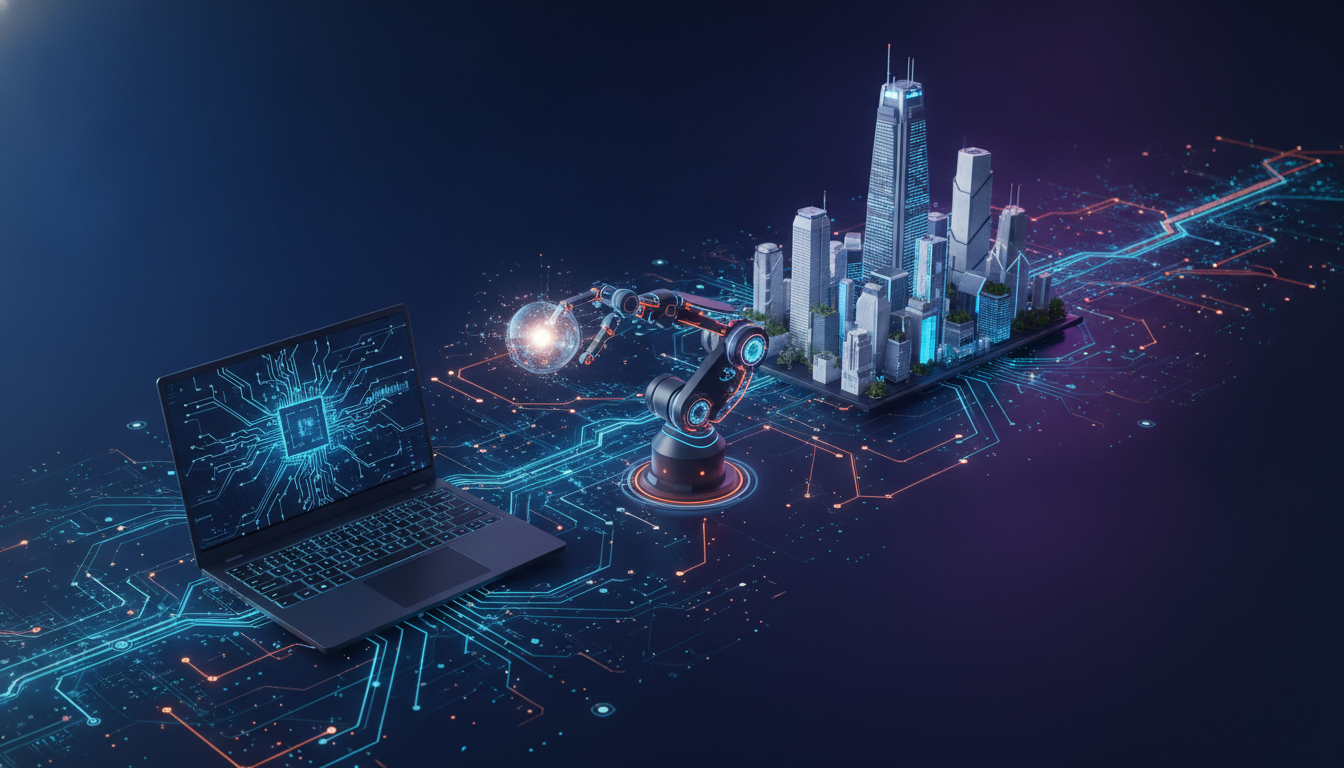
The defining characteristic of Computex 2026 was the emergence of a "Compute Continuum" – a hybrid architecture that intelligently routes AI workloads between local NPUs (Neural Processing Units) and cloud servers. This dynamic approach, driven by factors like task complexity, latency, and privacy, signifies a sophisticated understanding of AI deployment that prioritizes efficiency and user experience.
Agentic AI: The Year of the Intelligent Agent
Perhaps the most significant conceptual shift was the widespread embrace of "Agentic AI." Qualcomm CEO Cristiano Amon boldly declared 2026 the "Year of the Agent," signaling a future where AI systems act autonomously to achieve user goals, rather than merely responding to prompts. This paradigm shift is expected to unlock substantial new computing demand, as these agents require continuous, on-device processing power to operate effectively and contextually.
Alongside agentic systems, "Physical AI" or "Embodied AI" took center stage. The inaugural AI Robotics Zone showcased how AI is rapidly moving beyond digital realms to control physical systems in manufacturing, logistics, healthcare, and aerospace. This transition from digital intelligence to real-world execution represents a massive market opportunity, with projections suggesting the Physical AI market could reach €430 billion globally by 2030. The question is no longer if AI will transform industries, but how quickly it can be deployed into the physical world.
Hardware Titans Battle for AI Dominance
The push for practical AI is fueling an intense, four-way processor battle among industry titans: NVIDIA, Intel, Qualcomm, and AMD. Each showcased groundbreaking innovations designed to power the next generation of AI-enabled devices and data centers, emphasizing local AI inference as a standard hardware specification.
- NVIDIA's Generative AI Superchip: NVIDIA unveiled the RTX Spark SoC, an Arm-based N1X "superchip" featuring up to 20 Grace CPU cores and 6,188 RTX Blackwell GPU cores. This powerhouse platform offers up to 1 petaflop of local AI compute and 128GB of unified memory, capable of running colossal 120-billion-parameter LLMs directly on a device. They also introduced the Vera Rubin AI computing platform and Vera CPU for the agent-based AI era, alongside Cosmos 3 for Physical AI and NVIDIA Isaac Groot as a humanoid robotic stack.
- Intel's Rackscale Innovations: Intel countered with new chip-to-systems-level AI innovations, including rackscale AI infrastructure leveraging Intel Xeon processors and SambaNova SN-50 RDUs. The Intel Xeon 6+ processors, built on the Intel 18A process node, are tailored for high-density, scale-out, and agentic AI workloads in data centers. For consumers, the Core Ultra Series 3 debuted as the first consumer AI PC platform entirely on 18A, powering over 300 PC designs.
- Qualcomm's On-Device Efficiency: Qualcomm expanded its Snapdragon X presence and introduced the budget-friendly Snapdragon C series for entry-level Windows AI PCs, starting near $300. Their demonstrations highlighted significant token reduction and cost savings achieved by keeping basic AI processing on-device, emphasizing the efficiency gains of local AI.
- AMD's Competitive Edge: AMD showcased its Ryzen AI Max 400 APUs with up to 128GB of unified memory for x86 laptops, directly competing in the burgeoning local AI compute space and offering robust performance for on-device AI tasks.
Microsoft also played a pivotal role, debuting the Surface Laptop Ultra with a strong emphasis on local AI processing and up to 128GB of unified memory. They are anchoring the control plane for agent ecosystems with Agent 365 and Entra ID, solidifying their position in the software layer of the agentic AI future.
| Company | Key AI Product/Platform | Primary Focus | Highlight Metric/Feature |
|---|---|---|---|
| NVIDIA | RTX Spark SoC, Vera Rubin, Isaac Groot | High-performance On-Device AI, Physical AI, Agentic AI | 1 Petaflop local AI compute, 128GB unified memory |
| Intel | Xeon 6+, Core Ultra Series 3, Rackscale AI | Data Center AI, Consumer AI PCs | Intel 18A process node, 300+ PC designs |
| Qualcomm | Snapdragon X, Snapdragon C series | On-Device AI for PCs (budget to premium) | Significant token reduction, ~$300 entry-level AI PCs |
| AMD | Ryzen AI Max 400 APUs | On-Device AI for x86 Laptops | Up to 128GB unified memory for local AI |
| Microsoft | Surface Laptop Ultra, Agent 365 | AI PCs, Agent Ecosystem Control Plane | Local AI processing, Agent 365 for workflow orchestration |
The Road Ahead: From Hype to Hyper-Utility
Computex 2026 unequivocally demonstrated that the global AI ecosystem is moving past foundational research into a phase of aggressive deployment and integration. The industry's collective energy is now directed at solving real-world problems through AI, whether by making personal computers profoundly smarter, automating complex industrial processes, or enabling intelligent agents to handle sophisticated tasks autonomously.
This pivot to practicality means that the market will increasingly reward solutions that offer demonstrable utility and seamless integration. As the PC market becomes more fragmented and competitive, and the Physical AI market surges towards its projected €430 billion valuation, the ability to bridge the gap between digital intelligence and tangible, real-world impact will be the ultimate differentiator for success in the evolving AI landscape.