$ open posts/global-fabless-semiconductor-leaders-headquarters-key-products
Global Fabless Semiconductor Leaders: Headquarters and Key Products
Projections indicate the global fabless IC market, valued at an estimated $161.64 billion in 2026, is set to exceed $258.58 billion by 2035, demonstrating a robust compound annual growth rate (CAGR) of over 5.3%. This expansion is not merely incremental; global semiconductor revenue is forecasted to surpass $1.3 trillion in 2026, a growth rate not seen in two decades. AI compute demand is a primary catalyst, with AI semiconductors expected to constitute roughly 30% of total semiconductor revenue in 2026, reflecting significant investments in AI infrastructure by major cloud service providers.

The Surging Fabless IC Market: Trends and Growth Drivers
The vitality of the fabless sector is deeply intertwined with several key trends shaping the broader technology landscape. The relentless pursuit of AI capabilities, from machine learning acceleration to sophisticated inference engines, has created an unprecedented demand for specialized chips. Companies designing AI accelerators, particularly GPUs and custom ASICs, are experiencing explosive growth, benefiting directly from the substantial capital expenditure of cloud service providers.
Beyond AI, the consistent growth in consumer electronics continues to be a foundational pillar for the fabless IC market. Smartphones, wearables, gaming consoles, and smart home devices all rely on advanced, power-efficient chips, driving innovation and volume for fabless designers. Geographically, while Asia-Pacific currently holds a significant 31.2% share of the fabless IC market, North America is anticipated to lead in growth by 2035, highlighting a dynamic global competitive landscape.
Global Fabless Powerhouses: Headquarters and Key Products
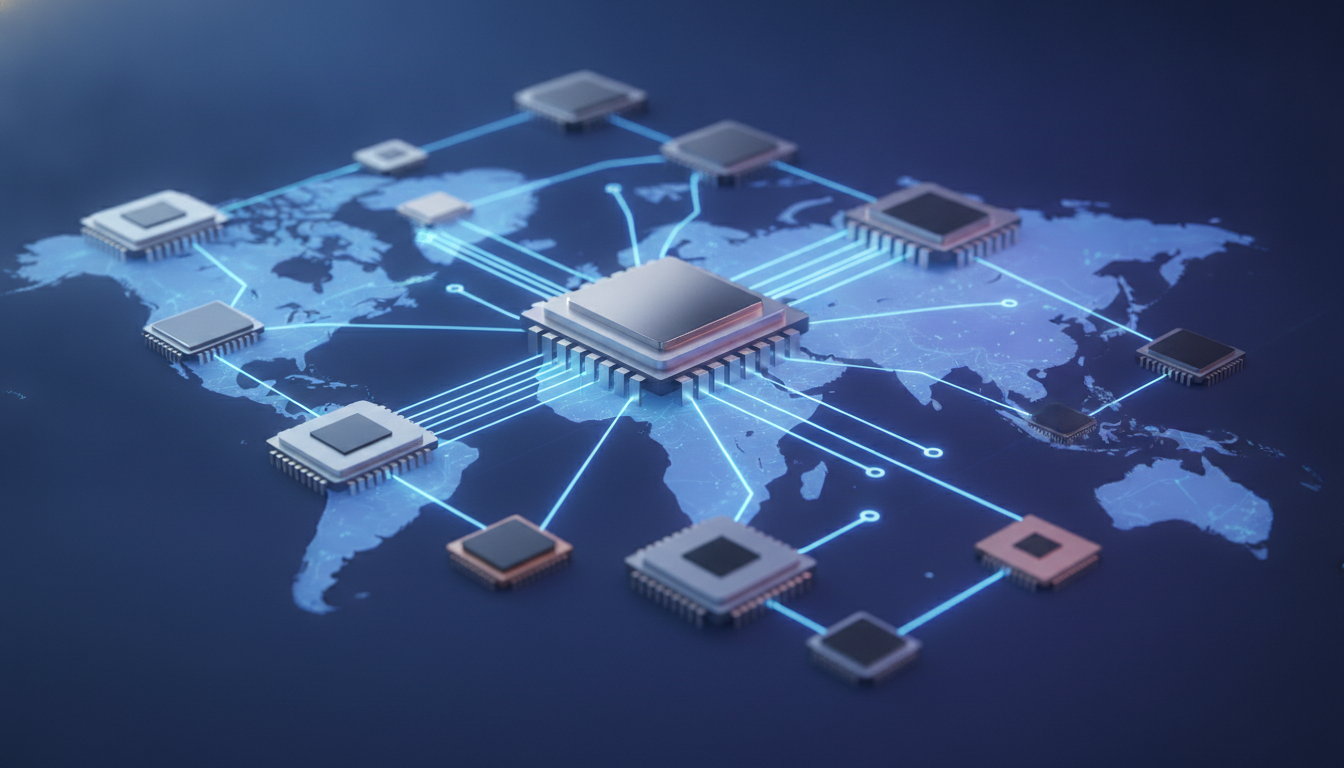
The top fabless IC design houses collectively generated over US$359.4 billion in revenue in 2025, a testament to their market dominance and innovation. These companies are not just designing chips; they are architecting the future of technology across diverse applications. Here’s a look at some of the leading players, their origins, and what they bring to the market:
| Company | Headquarters | Main Products/Focus |
|---|---|---|
| Nvidia Corporation | Santa Clara, California, U.S. | GPUs, data center GPUs, AI chips, AI accelerators |
| Broadcom Inc. | San Jose, California, U.S. | Network chips, broadband communication chips, storage chips, custom silicon, AI networking |
| Qualcomm Inc. | San Diego, California, U.S. | Wireless communication semiconductors, 5G smartphone chips, automotive chips |
| Advanced Micro Devices Inc. (AMD) | Santa Clara, California, U.S. | CPUs, GPUs, server processors, AI accelerators, data center solutions |
| MediaTek Inc. | Hsinchu, Taiwan | Mobile chips (Dimensity series processors) |
| Marvell Technology Inc. | Santa Clara, California, U.S. | Cloud networking semiconductors, customized XPUs, optical interconnect |
| Realtek Semiconductor Corporation | Hsinchu, Taiwan | General ICs, audio codecs, network controllers |
| Novatek Microelectronics Corp. | Hsinchu, Taiwan | Display Driver ICs (DDIs), Touch and Display Driver Integration ICs (TDDI ICs) |
| Intel FPGA | San Jose, California, U.S. | FPGAs (Field-Programmable Gate Arrays) |
| Monolithic Power Systems (MPS) | Kirkland, Washington, U.S. | Power management ICs |
| Cirrus Logic | Austin, Texas, U.S. | Audio and mixed-signal ICs |
Innovations Driving Market Leadership
Many of these companies are not just maintaining their positions but are actively innovating to capture new market segments. Nvidia, for instance, saw its data center revenue account for a staggering 90% of its total Q4 2025 revenue, underscoring its dominance in AI computing. Broadcom is making significant strides with its custom silicon and AI networking products, essential for the high-speed, low-latency demands of modern data centers. Qualcomm continues to lead in wireless communication, with its 5G smartphone chips and expanding presence in the automotive sector.
Taiwanese powerhouses like MediaTek and Realtek demonstrate the strength of the Asia-Pacific region in diverse IC categories, from mobile processors to essential general-purpose ICs. The collaboration between companies like Marvell Technology and Nvidia on optical interconnect and silicon photonics further illustrates the strategic partnerships forming to push the boundaries of chip technology. These collaborations are crucial for developing the next generation of high-performance computing and networking solutions.
The trajectory of the global fabless semiconductor market is one of rapid expansion and continuous innovation. As AI continues to embed itself across industries and consumer electronics become ever more sophisticated, the companies designing these foundational chips will remain pivotal to technological progress. Understanding their core offerings and strategic directions provides a clear picture of where the digital world is headed.