$ open posts/hollywood-ai-reckoning-generative-video-entertainment-revolution
Hollywood's AI Reckoning: Crisis or Creative Revolution for Entertainment?
Hollywood, the global epicenter of storytelling, finds itself at a pivotal crossroads. The rapid ascent of generative artificial intelligence (AI) is not merely another technological advancement; it's a fundamental shift, presenting both a profound crisis and an unprecedented opportunity for the entertainment industry. From script to screen, AI promises to redefine workflows, democratize creation, and unlock new narrative possibilities, yet it simultaneously casts a long shadow over job security, intellectual property, and the very essence of human creativity.
This isn't a distant future scenario. Studios are already grappling with how to integrate these powerful tools while navigating the complex ethical and economic implications. The tension is palpable: embrace the future or risk being left behind, all while protecting the human element that has always been Hollywood's beating heart.
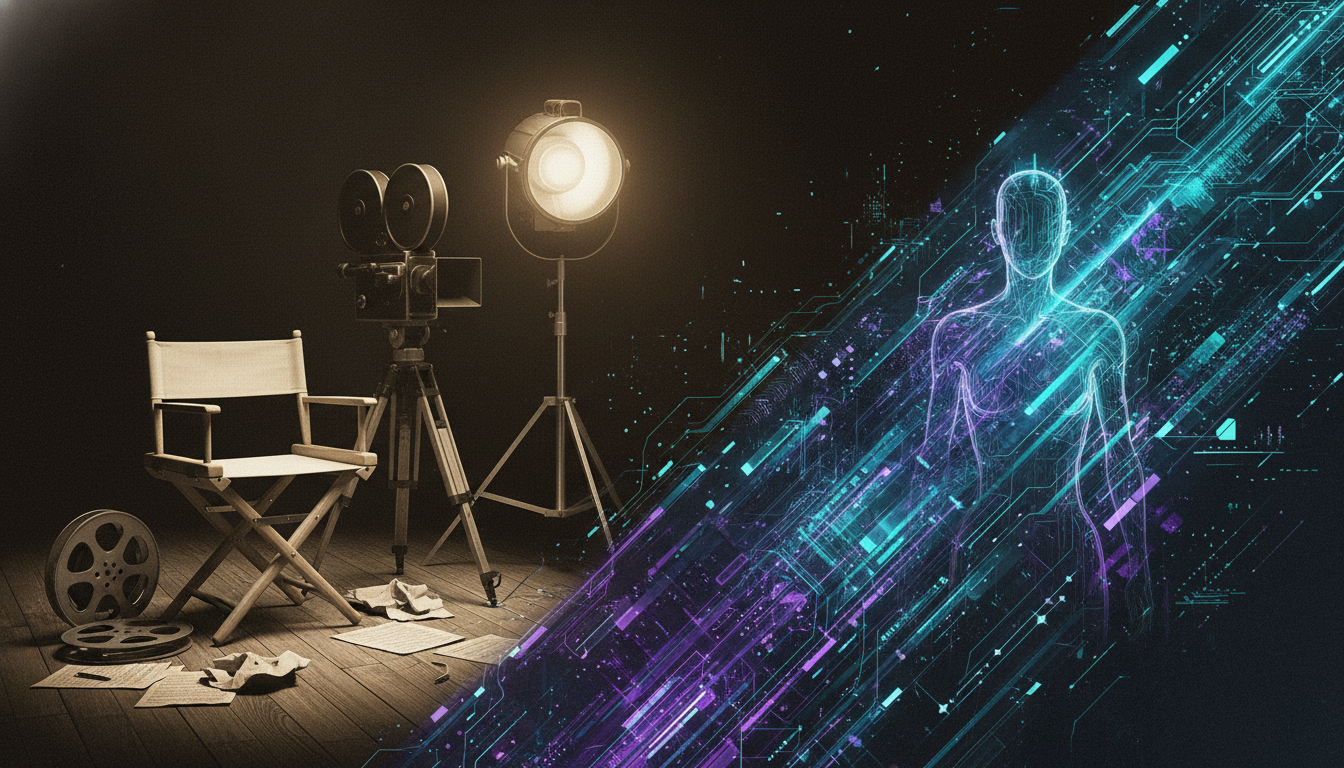
The Shifting Sands of Production: AI's Dual Impact
The immediate impact of generative AI in Hollywood is bifurcated. On one hand, studios are cautiously exploring its potential for content creation. Deloitte predicts that major U.S. and E.U. studios will allocate less than 3% of their production budgets to generative AI tools for creative output by 2025. This reticence stems from concerns over quality, control, and the nascent stage of the technology.
Conversely, the adoption rate for operational functions is far more aggressive. Studios are readily integrating generative AI into areas like contract and talent management, marketing, localization, dubbing, and content discovery. An estimated 7% of operational spending is projected to shift to these AI-enabled tools. McKinsey reports indicate that AI is already showing potential for 5 to 10 percent productivity increases in specific production use cases, particularly in development and pre-production workflows, signaling a clear path to efficiency gains.
The Uncanny Valley and Breakthroughs
Early generative video tools often struggled with consistency, coherence, and the dreaded 'uncanny valley' effect, where visuals felt almost real but subtly off, failing to achieve true cinematic quality. However, the pace of innovation is staggering. Models like Google Veo 3 are now cited for their 1080p output and best-in-class lipsync, while Kling AI also shows impressive progress in this critical area.
A significant turning point arrived in early 2026 with ByteDance's Seedance 2.0. This model is reportedly capable of generating multi-scene, cinematic videos with consistent characters and synchronized audio from simple text prompts, a development that has caused 'full-blown panic' within Hollywood circles. This leap suggests that the 'Hollywood-level' production quality once thought distant is now within reach, challenging traditional production paradigms.
Democratizing Creativity and Navigating the IP Minefield
While the established studios cautiously dip their toes, generative AI is already democratizing filmmaking at an unprecedented scale. These tools are dramatically lowering barriers to entry, empowering independent creators, smaller production houses, and even individual artists to produce high-quality visuals and explore novel storytelling formats with budgets previously unimaginable. This surge in accessible creative power promises an explosion of diverse content, but also raises questions about market saturation and the value of content in an increasingly crowded digital landscape.
However, this revolution is not without its significant challenges, particularly concerning labor and intellectual property. Guilds and unions across Hollywood—including the WGA, DGA, and SAG-AFTRA—have voiced profound concerns about AI's potential to displace human roles, advocating for AI to augment rather than replace creative talent. Studies anticipate over 203,000 jobs in the U.S. could be disrupted by 2025, with 62,000 in California alone. Beyond job security, the unauthorized use of copyrighted works for training AI models and the legal ambiguities surrounding AI-generated content present a formidable IP minefield. Studios are understandably wary of partnering with AI companies, fearing data usage controversies and potential legal battles.
Opportunities vs. Challenges: A Snapshot of Generative AI in Entertainment
| Opportunity | Challenge |
|---|---|
| Reduced production costs (e.g., Lionsgate's target of $100M to $50M for some projects) | Significant job displacement concerns across guilds (WGA, DGA, SAG-AFTRA, IATSE) |
| Increased productivity in pre-production (McKinsey: 5-10% gains) | Intellectual Property (IP) and copyright infringement risks from training data |
| Democratization of filmmaking, enabling independent creators | Risk of market inundation with AI-generated content, potentially devaluing human work |
| Faster operational tasks (marketing, localization, dubbing, content discovery) | "Uncanny Valley" effect and quality control issues for complex narratives (though rapidly improving) |
| New creative possibilities and storytelling formats | Erosion of trust in video as evidence due to deepfakes and misinformation potential |
The entertainment industry stands at a precipice, facing a future where the lines between human and machine creativity blur. The challenge for Hollywood is not merely to adopt new tools, but to redefine its relationship with technology, ensuring that innovation serves creativity and human talent, rather than supplanting it. The coming years will undoubtedly be a period of intense negotiation, adaptation, and perhaps, a renaissance of storytelling in forms we are only just beginning to imagine.